You know that feeling when you stare at a cluttered kitchen cabinet and think, “I’ll organize this whole thing this weekend”? Then the weekend comes, you open that cabinet, and the overwhelm hits so hard you close the door and walk away. That’s not laziness. That’s your brain doing exactly what it’s designed to do when faced with a massive task.
The real secret to building lasting organizing habits isn’t motivation or willpower. It’s understanding how your brain responds to small wins and using that response to rewire how you approach clutter. When you start small with decluttering, you’re not just tidying up – you’re triggering a chain reaction of psychological shifts that make future organizing feel less like a chore and more like something you actually want to do.
Starting small with decluttering works because your brain releases dopamine when you complete tasks, no matter the size. This creates a positive feedback loop that builds momentum, making you more likely to organize again. Neuroscience shows that small wins activate the same reward centers as big accomplishments, but with less resistance and burnout risk.
How Your Brain Actually Responds to Decluttering Tasks
There’s a reason you can’t just force yourself to organize an entire room and stick with it. Your brain has something called a “cognitive load” – basically, how much information and decision-making it can handle at once. When you look at a packed pantry or overflowing junk drawer, you’re not just seeing items. You’re facing hundreds of micro-decisions: Keep or toss? Where does this belong? Do I actually use this?
That decision fatigue is real. Studies on decision-making show that your brain gets exhausted from choices, which is why organizing a massive space often leaves you mentally drained before you’ve made physical progress. The moment you feel that exhaustion, your brain sends a signal to stop. It’s self-protection, not failure.
When you tackle something small – like one shelf, one drawer, or one category of items – you reduce the cognitive load dramatically. Fewer decisions means less mental fatigue. And here’s the key part: when you finish that small task, your brain releases dopamine, a neurotransmitter associated with reward and motivation. You feel accomplished. That feeling matters more than you think.
The Momentum Effect – Why Small Wins Lead to Bigger Changes
Psychologists call this the “progress principle.” People are most motivated when they make tangible progress on meaningful work. The catch? Progress doesn’t have to be huge. A small, visible win triggers the same motivational response as a larger one, but it’s much easier to achieve.
Here’s what happens in practice: You spend 15 minutes clearing one kitchen shelf. You see the empty space, the organized items, the trash bag with things you removed. That’s concrete progress. Your brain registers it as a success. The next day, you feel slightly more motivated to tackle another small area because you know what success feels like.
This is different from motivation-based organizing, where you pump yourself up to do a big project. That kind of motivation fades fast. Momentum-based organizing builds on itself. Each small win makes the next action feel more natural, less forced. After a few days of small decluttering sessions, you’ve reorganized multiple areas without ever hitting that wall of overwhelm.
The psychological term for this is “implementation intentions” – when you complete one task, your brain becomes primed to take on similar tasks. You’re literally rewiring your neural pathways to see organizing as something doable, even enjoyable.
Why All-or-Nothing Organizing Fails (And How to Avoid It)
The typical organizing approach goes like this: Pick a day. Clear your schedule. Attack the clutter with full force. Maybe you get through half the space before exhaustion sets in. You stop. Nothing changes structurally, so the clutter creeps back. You feel like you failed.
This is the “all-or-nothing” trap, and it’s particularly common with home organization because we’re taught that real change requires dramatic action. But that’s not how habits actually form. Habits build through repetition and small reinforcements, not through one massive effort.
When you try the all-or-nothing approach, you’re fighting against your brain’s natural limits. You’re also setting yourself up for the “false hope syndrome” – that feeling where you think this time will be different, only to find yourself back where you started. Each failed attempt makes you less likely to try again.
Starting small sidesteps this entirely. A 15-minute organizing session is something you can actually complete. When you complete it, you build confidence. When you repeat it a few times, you build a habit. By the time you’ve spent an hour total on decluttering across several days, you’ve reorganized more than you would have in one exhausting weekend – and you actually want to keep going.
Building the Habit – How Repetition Rewires Your Brain
Neuroscience research shows that habits form through repetition in a consistent context. Your brain essentially creates shortcuts for repeated behaviors, moving them from the “conscious effort” category to the “automatic” category. This is why brushing your teeth doesn’t require willpower – it’s a habit.
The same principle applies to organizing. When you declutter the same small space at the same time consistently, your brain starts to anticipate it. The friction decreases. What took mental effort on day one feels routine by day ten.
Here’s the practical side: Pick one small area – a kitchen shelf, a bathroom cabinet, a single drawer. Spend 10-15 minutes on it three times a week. Don’t jump to new areas until this one feels easy. Your brain needs the repetition to build the neural pathway. After two to three weeks, organizing that space will feel automatic. Then you can add another small area.
This layered approach means you’re building multiple small habits rather than one massive one. Each habit reinforces the others. You’re not just organizing; you’re training your brain to see clutter differently and respond to it more naturally.
The Role of Visibility in Sustaining Momentum
One reason small decluttering sessions work so well is that the results are immediately visible. You finish clearing one shelf, and you can see exactly what you accomplished. That visual feedback is crucial for maintaining momentum.
When you work on a huge project, progress can feel invisible. You might spend three hours and feel like nothing’s changed because the overall space still looks messy. With small sessions, you see the transformation immediately. That visibility keeps the motivation alive.
This is why organizing one kitchen drawer feels more satisfying than partially organizing an entire kitchen. The completed drawer is proof of progress. Your brain loves proof.
Common Obstacles and How to Work Around Them
Getting stuck on decisions
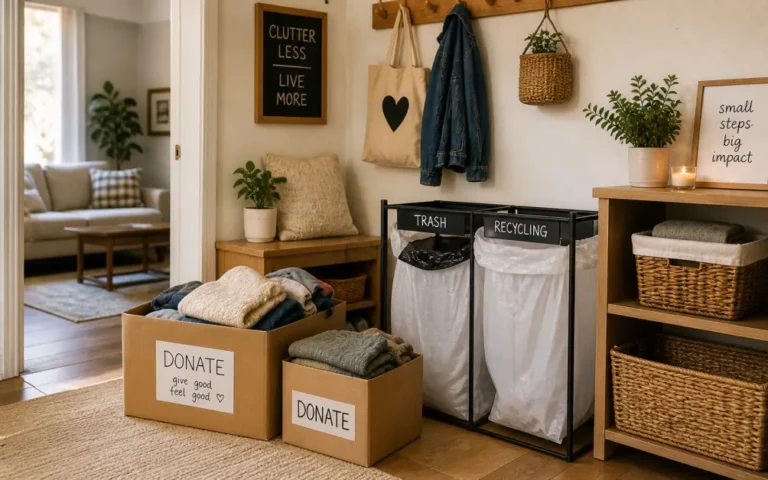
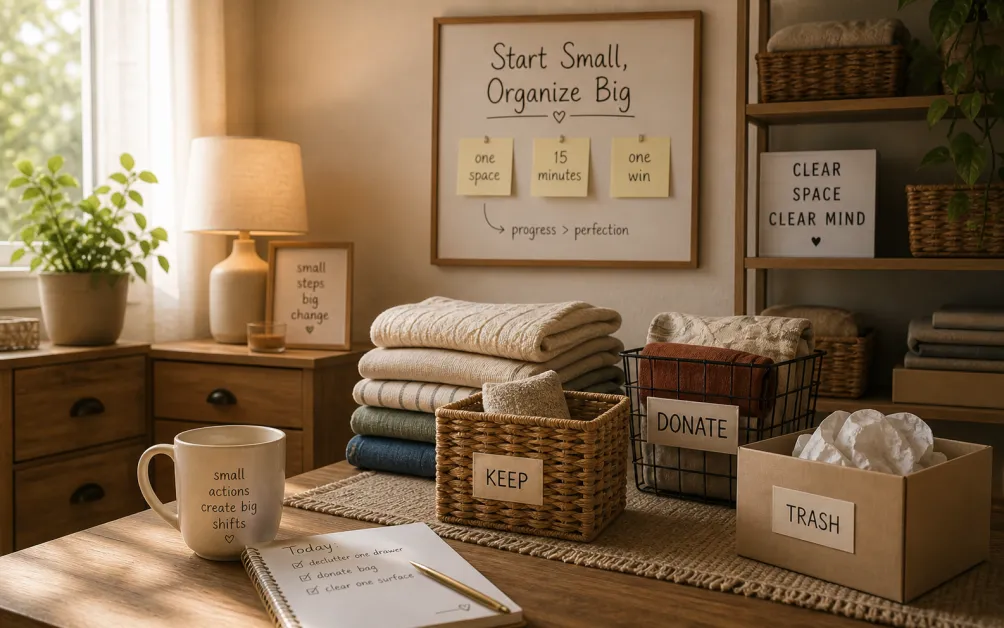
If you find yourself stalling while decluttering, you’ve hit decision fatigue. The fix: set a timer for 15 minutes and make quick decisions. Don’t overthink. Keep, donate, or trash – those are your only three options. Once the timer goes off, you’re done, regardless of whether you’ve finished the space. This prevents decision paralysis and keeps the momentum going.
Losing steam between sessions
If you organized one shelf and then didn’t touch anything for two weeks, you’ve lost the habit-building momentum. The solution is consistency, not perfection. Even 10 minutes a few times a week keeps the neural pathway active. Think of it like exercise – a short walk three times a week beats one long hike every month.
Organizing but not actually decluttering
There’s a difference between moving clutter around and actually removing it. Organizing without decluttering doesn’t create real change. Before you organize, you have to declutter. Decide what actually stays. Remove everything else. Then organize what remains. This is the only way the habit sticks because you’re actually creating space, not just shuffling things.
FAQ – Questions About Decluttering Momentum
How long does it take to build an organizing habit?
Most research suggests 21-66 days depending on complexity. For simple habits like organizing one shelf, you’re looking at 2-3 weeks of consistent small sessions. For more complex organizing systems, closer to 6-8 weeks. The key is consistency, not speed.
Does starting small mean I’ll never finish organizing my whole home?
Actually, the opposite. People who start small are significantly more likely to finish because they don’t hit burnout. You’re building momentum across weeks, not trying to cram everything into one weekend. You’ll end up with more organized spaces, faster, because you’re not fighting your brain’s natural limits.
What if I don’t have 15 minutes? Can I do 5-minute sessions?
Yes, but with a caveat. Five-minute sessions work for very simple tasks – clearing one shelf, sorting one drawer. Anything more complex needs at least 10-15 minutes because you need time to make decisions and see visible progress. The visible progress is what triggers the dopamine response that keeps you coming back.
Should I organize everything at once or tackle one room at a time?
Start with one small area – a single shelf or drawer. Once that feels automatic, add another. This prevents cognitive overload and lets you build multiple small habits instead of one overwhelming project. Your kitchen will be organized faster this way because you’re not burning out.
What happens if I skip a few days of organizing?
You lose some momentum, but not all of it. Habits are resilient. If you skip 2-3 days, just pick it back up. If you skip a week, you might need to rebuild slightly, but the neural pathway doesn’t disappear. The key is getting back to it rather than giving up entirely.
Last Words
Organizing your home isn’t about finding the right system or having enough willpower. It’s about working with how your brain actually functions. Small, consistent decluttering sessions trigger real psychological rewards that build momentum over time. You’re not just tidying up – you’re rewiring how you respond to clutter. Start with one small space. Finish it. Feel the win. Then do it again. That’s how lasting organizing habits actually form