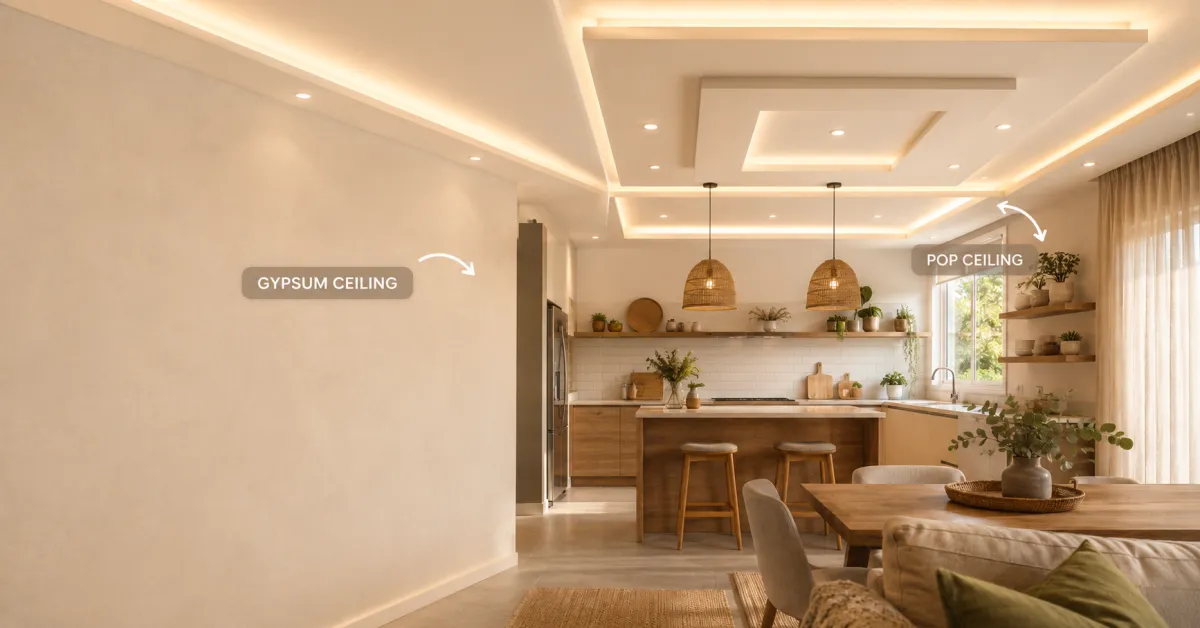
When you’re planning a false ceiling for your hall, you’re likely staring down two main options – POP (Plaster of Paris) and gypsum. Both can transform a room’s look and hide unsightly wiring or uneven surfaces, but they’re not interchangeable. The choice between them comes down to your budget, climate, maintenance tolerance, and how long you want the ceiling to last.
Here’s the quick answer – POP is cheaper upfront and easier to customize with intricate designs, while gypsum is more durable, moisture-resistant, and requires less maintenance over time. POP works best in dry climates and for decorative ceilings you don’t mind refreshing every few years. Gypsum is the smarter long-term investment if you live in humid areas or want a ceiling that stays looking good with minimal fuss.
What Are POP and Gypsum False Ceilings?
POP (Plaster of Paris) false ceilings are made from a white powder that hardens when mixed with water. It’s applied over a metal or wooden framework to create a smooth, finished surface. You can mold it into virtually any shape – ornate designs, curved edges, recessed lighting fixtures – which is why it’s popular for decorative work.
Gypsum false ceilings use gypsum boards (also called drywall or plasterboard) that are pre-manufactured and fixed to a suspended frame. They’re essentially large panels with a gypsum core wrapped in paper. The joints are then taped and finished with joint compound to create a seamless look.
POP False Ceilings – Pros and Cons
Advantages of POP
- Lower initial cost – POP is significantly cheaper than gypsum, making it appealing if you’re working with a tight budget
- Unlimited design flexibility – You can create ornate patterns, curves, domes, and custom shapes that would be difficult with rigid boards
- Seamless finish – Once dried and painted, there are no visible joints or seams, giving a uniform appearance
- Good for acoustic work – Can be layered with sound-dampening materials if needed
Disadvantages of POP
- Moisture sensitivity – POP absorbs water easily, making it problematic in humid climates, kitchens, or bathrooms. It can sag, crack, or develop mold
- Longer installation time – The application process is slower since it requires mixing, application, drying between coats, and finishing work
- Maintenance and repairs are messy – Cracks need to be patched with more POP, and touch-ups often show. Repainting the entire ceiling is common
- Shorter lifespan – Typically lasts 5-10 years before it starts showing wear, cracking, or needing repainting
- Heavier material – Puts more weight on the structure, requiring stronger support systems
- Dust during installation – The application process creates significant dust, which can be inconvenient if you’re living in the space
Gypsum False Ceilings – Pros and Cons
Advantages of Gypsum
- Moisture resistant – Especially moisture-resistant varieties (like those with additives) hold up well in humid kitchens, bathrooms, or coastal areas
- Faster installation – Boards come pre-made and just need to be fixed to the frame, then joints are taped and finished. Much quicker than POP application
- Low maintenance – Once installed and painted, it stays looking clean with minimal upkeep. Small cracks can be patched easily without redoing the whole ceiling
- Longer lifespan – Properly installed gypsum ceilings can last 15-20+ years without major issues
- Better sound insulation – The board density provides natural sound dampening
- Fire-resistant options available – Type X gypsum boards offer enhanced fire protection, important for safety-conscious homeowners
- Lighter weight – Easier on your structural support system
Disadvantages of Gypsum
- Higher upfront cost – Gypsum boards and installation labor are more expensive than POP
- Limited design flexibility – You’re working with flat panels, so ornate curves or complex patterns aren’t really possible without custom work
- Visible joints – Even with skilled finishing, you may see faint lines where boards meet, especially under certain lighting
- Damage visibility – Dents or holes are more obvious and harder to hide than small cracks in POP
- Requires skilled finishing – Getting a truly seamless look requires experienced tapers and finishers, which adds labor costs
POP vs Gypsum – Side-by-Side Comparison
| Factor | POP | Gypsum |
|---|---|---|
| Initial Cost | Low | Medium-High |
| Installation Time | Slow (5-10 days typical) | Fast (2-3 days typical) |
| Moisture Resistance | Poor | Good-Excellent |
| Design Flexibility | Excellent | Limited |
| Lifespan | 5-10 years | 15-20+ years |
| Maintenance | High (frequent touch-ups) | Low |
| Repair Difficulty | Visible patches common | Easy, less noticeable |
| Weight | Heavy | Light |
| Dust During Installation | Significant | Minimal |
Which Should You Choose for Your Hall?
Choose POP if…
You have a tight budget and want decorative, custom designs. POP shines when you’re looking for ornate ceilings with detailed moldings, curves, or artistic elements. It’s also fine if you live in a dry climate with minimal humidity. Just be prepared to repaint and touch up every few years.
Choose Gypsum if…
You want a ceiling that stays looking good with minimal fuss, you live in a humid or coastal area, or you’re planning to stay in the space long-term. Gypsum is the practical choice for most modern homes because it balances durability with reasonable cost and doesn’t demand constant maintenance.
Key Factors to Consider Before Deciding
Climate and Humidity
This is the biggest differentiator. If your region gets high humidity, monsoon seasons, or you live near the coast, gypsum is worth the extra investment. POP will deteriorate faster in these conditions. In dry climates, POP is perfectly acceptable.
Your Budget Reality
POP costs less upfront – usually 30-40% cheaper than gypsum. But factor in repainting, repairs, and eventual replacement. Gypsum costs more initially but saves money over 15-20 years because you’re not constantly maintaining it.
Design Ambitions
Want an intricate, sculptural ceiling? POP is your material. Prefer clean, modern lines with recessed lighting? Gypsum works great. Be honest about how important decorative elements are to your vision.
How Long You’re Staying
If you’re renting or planning to move in 3-5 years, POP is fine. If you’re settling in for the long haul, gypsum makes more financial sense despite higher initial costs.
Common Questions About False Ceilings
Can you install POP over gypsum or vice versa?
Technically yes, but it’s not ideal. POP doesn’t adhere well to gypsum’s paper surface, and adding POP over gypsum increases weight. If you’re changing materials, it’s better to remove the old ceiling first. It costs more upfront but prevents problems later.
How much does installation typically cost?
POP usually runs 40-80 rupees per square foot for materials and labor, while gypsum ranges from 60-120 rupees per square foot depending on your location and finish quality. Prices vary significantly by region and contractor experience.
Which is better for kitchens and bathrooms?
Gypsum, without question. Moisture-resistant gypsum boards (sometimes labeled “green board”) are designed for these spaces. POP will absorb moisture, develop stains, and potentially grow mold. In kitchens and bathrooms, the extra cost of gypsum pays for itself in durability.
Can you paint over either material?
Yes, both can be painted. POP typically needs primer before paint, while gypsum also benefits from primer for even coverage. Gypsum holds paint better long-term without flaking or peeling as easily as POP.
What’s the difference between moisture-resistant gypsum and standard gypsum?
Moisture-resistant gypsum (often called MR gypsum or green board) has additives and a treated paper facing that resists water absorption. It costs slightly more but is essential for kitchens, bathrooms, and humid climates. Standard gypsum is fine for dry living spaces like bedrooms or living rooms.
The Takeaway
POP offers creative freedom and lower upfront costs, but demands ongoing maintenance and struggles in humid conditions. Gypsum is the more practical, durable choice for most modern homes – it goes up faster, lasts longer, and needs minimal care. If moisture, longevity, and low maintenance matter to you, gypsum wins. If you’re drawn to ornate designs and working with a lean budget in a dry climate, POP delivers. Think about your climate, how long you’re staying, and your tolerance for maintenance work. That usually makes the decision clear.