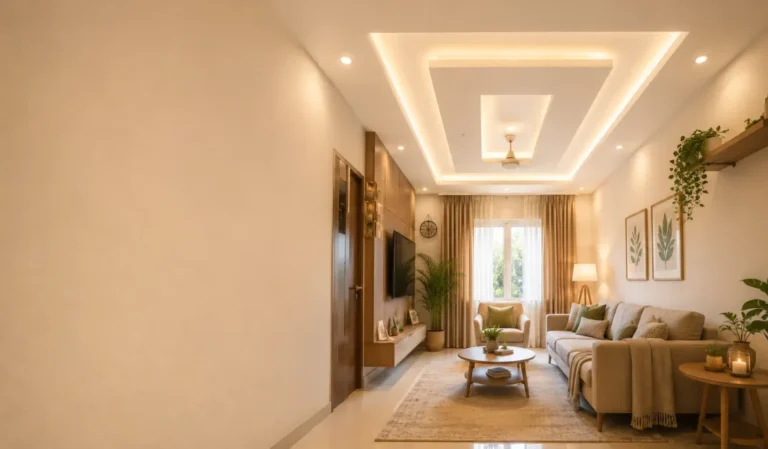
Your hall is the first thing people see when they walk through your front door. It sets the tone for your entire home. But if you’re staring up at a plain, flat ceiling right now, you’re missing a chance to add character without overwhelming the space.
Minimalist POP (Plaster of Paris) ceiling designs for halls offer a perfect balance – they add visual interest and sophistication through clean lines, subtle depth, and understated elegance. These designs work because they enhance your space without demanding attention, making halls feel more polished and intentional while keeping installation costs and maintenance reasonable compared to elaborate false ceiling options.
Why Minimalist False Ceilings Work for Halls
Halls are transition spaces. They’re not where you spend hours relaxing like a living room or cooking like a kitchen. That’s exactly why minimalist design works so well here. You want something that looks intentional without being distracting.
A cluttered, heavily patterned ceiling draws your eye upward and can make a hall feel cramped or dated. Minimalist POP designs do the opposite – they create visual flow that guides people through the space naturally. The subtle geometry and clean finishes feel modern without screaming for attention.
There’s also the practical side. Minimalist designs are easier to maintain than ornate ceilings. Less surface area means less dust collection, and simpler patterns don’t show imperfections as easily. Plus, if you ever need repairs, they’re straightforward and won’t require specialized craftspeople.
Popular Minimalist POP Ceiling Designs for Halls
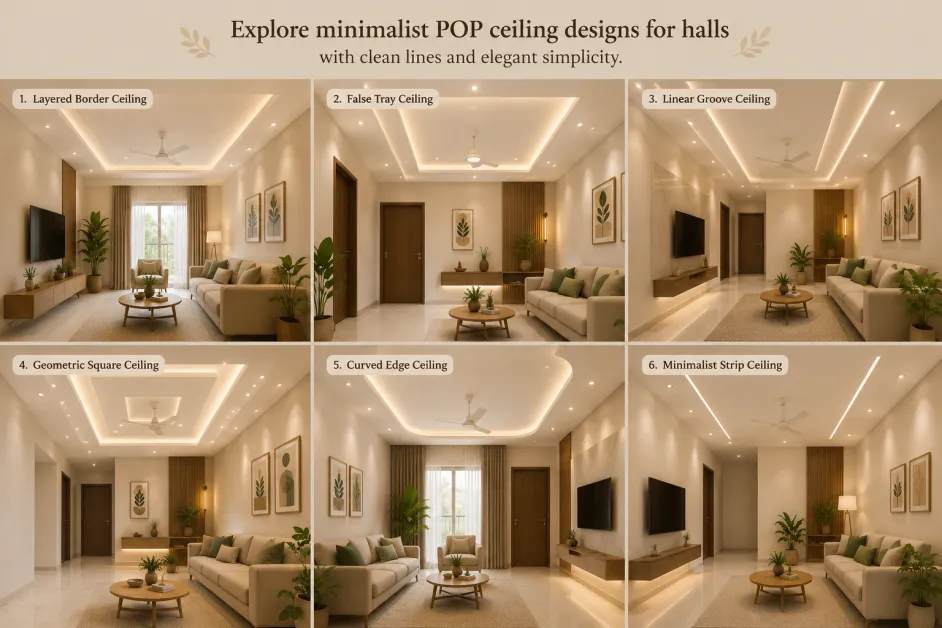
Straight Line Borders
This is the simplest approach and often the most effective. A single or double line of POP runs around the perimeter of your ceiling, creating a frame effect. It’s subtle enough to work in any hall, whether your space is traditional or contemporary. The line can be as thin as 2-3 inches or slightly wider depending on your ceiling height and hall dimensions.
Geometric Center Panels
A square or rectangular panel in the center of your ceiling gives you visual interest without covering the entire surface. You might use a simple recessed panel or one with subtle stepped detailing. This works especially well if you’re planning to add a chandelier or pendant light – the panel frames it perfectly.
Stepped or Layered Designs
Instead of a completely flat ceiling, create subtle depth with 2-3 layers of POP at different heights. The steps are gentle – maybe 3-6 inches of variation – creating shadow lines that add dimension. This approach feels contemporary and works well in halls with higher ceilings (9 feet or more).
Corner Accents
Keep the bulk of your ceiling flat but add small geometric elements in the corners. Think simple corner squares, triangles, or curved accents in POP. It’s a minimalist way to add personality without overwhelming the space.
Linear or Wave Patterns
Subtle parallel lines or gentle waves running across the ceiling create movement without chaos. These work best when kept to one direction and spaced evenly. The effect is calming and modern.
Design Considerations for Your Hall
Ceiling Height Matters
If your hall has a standard 8-foot ceiling, keep POP elements shallow – 2-4 inches maximum. Deeper designs can make the space feel cramped. For halls with 9-10 foot ceilings, you have more flexibility and can work with slightly more pronounced stepped or layered designs.
Hall Width and Length
A narrow, long hall benefits from designs that visually widen the space – think horizontal lines or side-to-side patterns. A wider hall can handle center-focused designs like geometric panels or corner accents. The goal is balance, not fighting your room’s natural proportions.
Lighting Integration
Plan your ceiling design around existing or planned lighting. A recessed center panel is the perfect spot for a chandelier or modern pendant. If you’re using flush-mount lights, keep the ceiling design simple so the lights feel intentional, not like an afterthought. Hidden LED strips along POP edges create elegant ambient lighting without visible fixtures.
Color and Finish
White or off-white remains the standard for minimalist ceilings because it reflects light and maintains the clean aesthetic. But you can experiment with subtle variations – warm white, soft gray, or even a very pale neutral. Keep the finish matte or satin, not glossy, to avoid a plastic appearance.
Installation and Cost Reality
Minimalist POP ceilings are more affordable than elaborate designs because they use less material and require less labor. Expect to pay between 30-60 rupees per square foot for basic designs, depending on your location and contractor expertise. A typical 12×12 hall might run 4,000-8,000 rupees for a simple border or center panel design.
Installation takes 2-5 days depending on complexity and your hall size. The process involves creating a frame, applying POP layers, finishing, and painting. Choose a contractor with experience in minimalist work – they’ll understand that precision and clean lines matter more than decorative flourishes.
Common Mistakes to Avoid
Going too thin. POP elements that are barely visible look unfinished. Aim for at least 2-3 inches of depth so the design actually casts subtle shadows and creates visual interest.
Ignoring proportions. A center panel that’s too small or too large relative to your hall looks off-balance. Work with your contractor to sketch designs to scale before starting work.
Overcomplicating the design. Minimalism means restraint. If you’re tempted to add multiple patterns, corner details, and center elements all at once, step back. Choose one focal point or one consistent element.
Skipping proper finishing. The difference between a polished minimalist ceiling and a mediocre one is in the details – smooth joints, even paint coverage, and clean lines. Don’t rush the finishing work.
Frequently Asked Questions
How long do POP ceilings last?
Well-installed and maintained POP ceilings typically last 10-15 years. They’re prone to cracking if there’s structural movement or water damage, but in a dry hall with no moisture issues, they hold up well. Regular painting every 5-7 years keeps them looking fresh.
Can I add a minimalist POP ceiling to an old hall?
Yes, but check the structural integrity first. If your existing ceiling is sagging or shows water damage, address that before adding POP. A structural engineer can assess whether your hall can handle the additional weight – typically 1-2 pounds per square foot for thin POP designs.
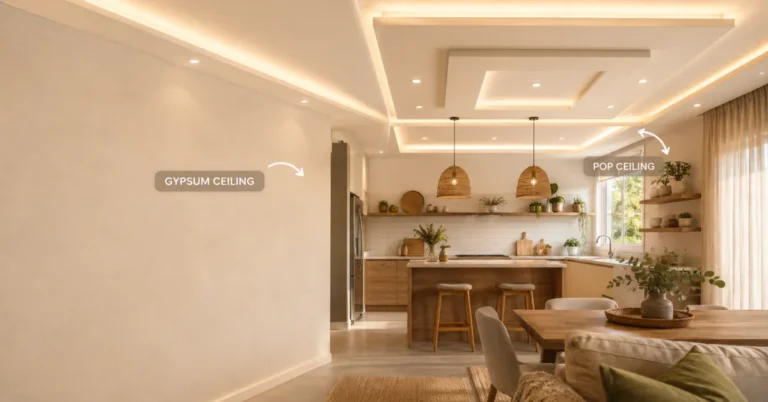
What’s the difference between POP and gypsum board false ceilings?
POP is more affordable and creates custom shapes easily, making it ideal for minimalist designs. Gypsum is more durable, fire-resistant, and better for moisture-prone areas. For a dry hall, POP works perfectly and gives you more design flexibility for minimal aesthetics.
Can I paint or update a minimalist POP ceiling later?
Absolutely. Repainting is straightforward and affordable. If you want to change the design significantly, it’s more involved – you’d need to remove and redo sections. But simple color changes or adding subtle details like painted accent lines are easy updates.
Do minimalist ceilings work in small halls?
Yes, actually better than elaborate designs. A simple border or thin center panel makes a small hall feel intentional and open, not cramped. Avoid deep recesses or heavy layering in compact spaces.
In Summary
Minimalist POP ceiling designs give your hall a polished, contemporary look without the cost or complexity of elaborate false ceilings. Whether you choose a simple border, geometric center panel, or subtle stepped design, the key is letting restraint work for you. A well-executed minimalist ceiling feels intentional and elevated – exactly the impression you want your hall to make when someone walks through your door.